Our services
Hospital Lighting
OR, patient room, corridor, and exterior lighting designed for NFPA 99 and life-safety branch compliance. Built for the buildings that can't go dark.

Healthcare lighting that meets Code 99.
Hospital electrical isn't general commercial work with a stethoscope. It's governed by NFPA 99 (Health Care Facilities Code) on top of NFPA 70 (NEC), with strict requirements for the essential electrical system - life-safety branch, critical branch, and equipment branch - plus red-receptacle conventions, generator backup, and automatic transfer switch (ATS) integration.
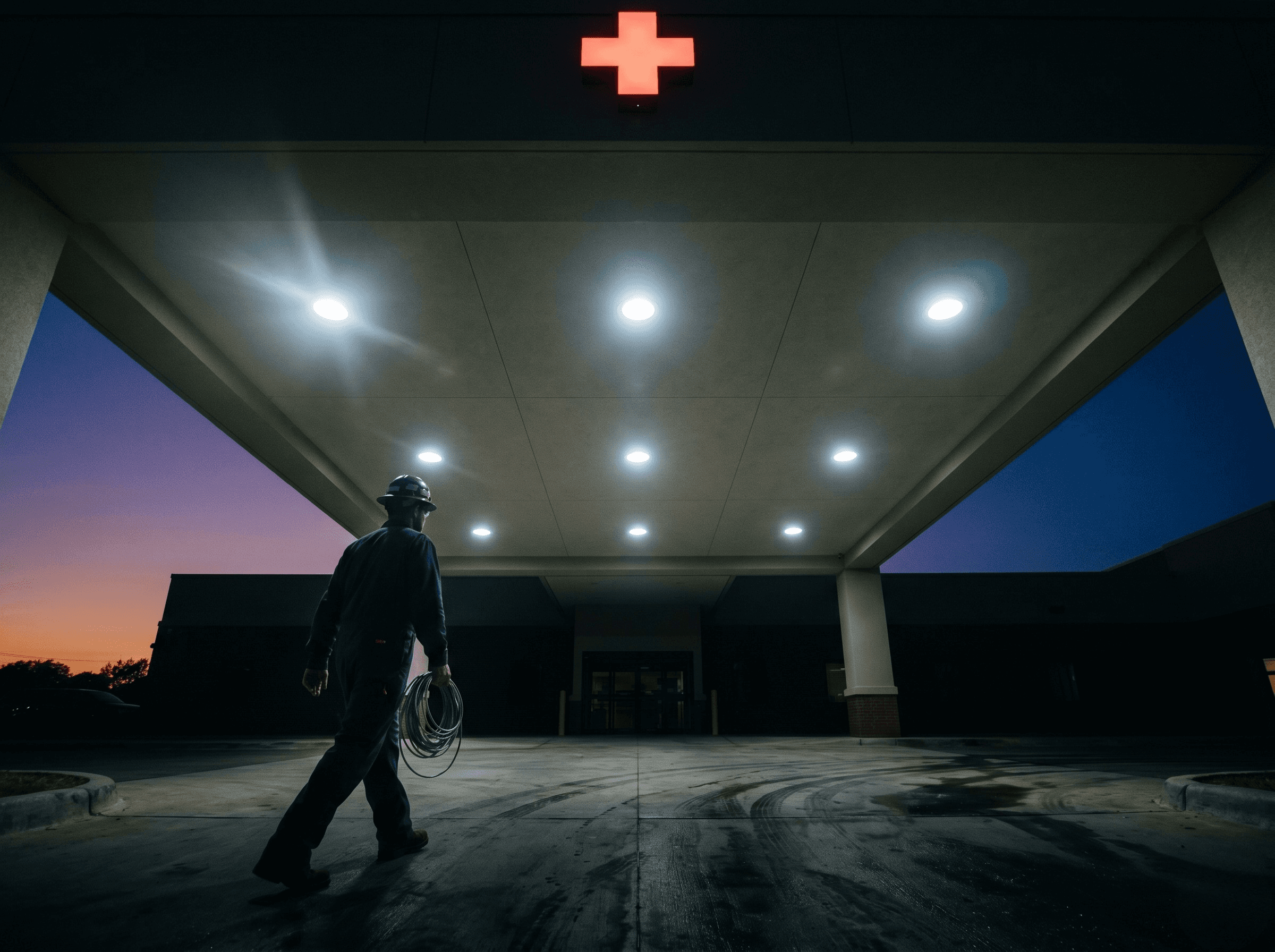
M4 Electric installs and services lighting across the full healthcare footprint: operating room and surgical suite fixtures, patient room and corridor lighting, emergency egress and life-safety branch wiring, exterior facility and helipad lighting, ambulance bay and ER canopy fixtures, imaging suite specialty lighting, pharmacy and lab fixtures, and ATS-backed circuits across the campus.
We work in occupied facilities. That means after-hours phasing, infection-control coordination with facility management, dust barriers, and zero patient-care interruption.
Why this work has to be done right.
NFPA 99 requires backup power for critical-care branch loads within 10 seconds of utility loss. Get it wrong and life-safety inspection fails - at best costing weeks of rework, at worst flagging the facility on its next CMS survey.
LED retrofits in healthcare deliver more than energy savings. A typical hospital corridor lit by older T8 or T12 fluorescents draws 30–40% more energy than a modern 4000K LED troffer system. Over a 5,000-fixture campus, that's $50,000+ annually in utility savings - plus reduced relamping labor (LED life is 50,000+ hours vs 20,000 for fluorescent).
How we deliver in a hospital environment.
Pre-construction coordination. We meet with the facilities team, infection-control lead, and AHJ before the first fixture comes down. Phasing plan documented. Dust barriers, negative-pressure HEPA filtration, and patient-pathway protection planned in.
After-hours and zoned execution. Most healthcare retrofits run in 4–8 hour overnight windows or weekend phases. Crews mobilize, complete the zone, restore the space to clinical standard, and hand back to staff before the next shift.
Life-safety branch verification. Every life-safety branch circuit is tested under load with the generator running. Test reports delivered to facility management and AHJ. Red receptacles labeled to NEC requirements.
Long-term service. Healthcare facilities don't stop. M4 keeps a 24/7 service line open for hospital clients — when an OR fixture fails or an ATS doesn't transfer, you reach a person.
Request a Quote
Trusted over 2k+ company


Explore more